Finance
Executive TechnicalWhich risks are driving this deal’s underperformance, and which contract terms, had you insisted on them, would have changed the outcome.
The Finance plug-in, vocabulary, structure, and the questions your leaders ask, already mapped. Nothing here starts from a blank page.
The QuestionWhich risks actually drove this deal's underperformance?
The MethodA causal model of deal risk factors, run counterfactually against alternate contract terms.
The AnswerA defensible account of which terms, had you insisted on them, would have changed the outcome.
01 The Decision
M&A DUE DILIGENCE has a systematic analytical failure that the deal-making process tends to amplify rather than correct. At Rung 1, the three teams who disagree at the board table, finance on valuation, strategy on fit, risk on customer concentration, are all partially observing the same upstream pressure: competitive deal dynamics and strategic urgency that simultaneously inflate every metric the board is looking at. At Rung 2, earnout structures are offered to targets with revenue uncertainty, which means observed integration outcomes for earnout deals already started from a higher-uncertainty position than cash-at-close deals. At Rung 3, management retention clauses are resisted by strong management teams, meaning the teams most likely to deliver integration are the ones the clause was designed to retain. The intervention query isolates each of these structural confounds from the observational comparison.
| Question | Standard Approach | Causal Approach |
|---|---|---|
| Which board concern is structural? | Review valuation, fit, and concentration independently | Diagnostic model traces all three back to Deal Competitive Pressure and Strategic Urgency confounders |
| Earnout effect on integration | Compare earnout vs cash-at-close deal outcomes | Intervention query severs Revenue Uncertainty confounder; isolates incentive mechanism from deal selection |
| Did the dropped clause cost us? | Compare integration to deal model target | Abduction anchors Management Quality and execution environment; counterfactual restores the clause |
02 The solution
- Which of the three competing board concerns, valuation multiple, strategic fit, or customer concentration, is the structural driver versus an artifact of deal competitive dynamics?: Rung 1 (Association). The graph encodes which dependencies exist between Deal Competitive Pressure, Strategic Urgency, and integration outcomes.
- What does requiring an earnout actually cause to management retention and integration speed, separate from the fact that earnouts are only offered when revenue is uncertain?: Rung 2 (Intervention). A do() query severs the Revenue Uncertainty and Target Management Motivation confounders, isolating the causal effect of the earnout structure.
- Would insisting on the management retention clause have changed integration performance on a deal that is now 35% below target?: Rung 3 (Counterfactual). Answering it requires abduction to anchor Management Quality and the actual adverse execution environment before restoring the contractual mechanism.
The solution was to model the relationships between the variables that drive deal performance, and to be explicit about which variables cause which. We recognised, for example, that management quality at the time of approval is not independent of the terms the acquirer demanded, boards that accept weaker management retention clauses tend to be accepting other risks too, which means the observed correlation between loose terms and poor outcomes overstates what tightening terms alone would deliver. Execution environment influences integration performance, but it also influenced which deals were pursued, making it a confounder that observational analysis cannot remove without structural assumptions. When you observe a variable in this model, you are effectively filtering the data to cases where that variable takes a particular value, and that filter ripples through the model, shifting related variables up and down accordingly. When you intervene on a variable, forcing it to a value regardless of what caused it, you break that ripple effect and get a cleaner answer: not what deals that look like this tend to produce, but what would happen if this specific term were required When you abduct, you extract a particular case from the averages, locking in its idiosyncratic circumstances before asking what would have happened if one or more things had been different.
03 What the solution answers
Deal Competitive Pressure and Strategic Urgency are the confounders. Contested auctions simultaneously inflate the multiple, compress diligence time, and suppress risk focus, so all three teams’ concerns are partially downstream of the same deal dynamics.
When only the deal approval decision is entered as evidence, all three concerns update, no single issue dominates. The board is not choosing between three independent concerns but managing one compound risk from deal dynamics that manifests across all three dimensions at once.
Revenue Uncertainty Level and Target Management Motivation are the confounders. Earnouts are offered specifically when acquirers have high revenue uncertainty, so observed earnout deals already started from a more uncertain position. The intervention query holds both confounders at their priors, isolating just the incentive mechanism.
The pure causal effect of earnout structures on management retention is negative at high revenue uncertainty, earnout disputes over target definitions become the primary reason senior management exits early. However, at moderate uncertainty the intervention shows a positive effect on integration speed through incentive alignment.
Management Quality is the confounder: strong managers resist retention clauses because they have leverage, and they also deliver better integration regardless of contractual structure. Abduction first anchors the unobserved background risk to this deal’s actual execution context. Then restoring the clause improves Personnel Continuity through the contractual pathway.
The model shows that the retention clause would have improved Personnel Continuity and through it Integration Performance, but not enough to bring the deal to target. The clause was not the deal’s primary failure point. Insisting on it would have moved the needle, but the board’s fundamental miscalculation was about management quality rather than contract structure.
04 Inside the Model
A language model can speak fluently about any domain. It cannot know one. The .bayes file is the knowledge the LLM is missing: a causal map of the domain, auditable, versioned, and wrong in specific correctable ways.
Optionally open MADueDiligenceCausal.bayes in Bayes Server or any equivalent tool. The model is the thing; the software that runs it is a commodity. The model is the thing; the software that runs it is a commodity.
A black checkmark = observed evidence (a fact entered as a filter). A red checkmark = do() intervention (a decision applied, severing the influence of parents).
Rung 1, Diagnostic: which board concern is structural?
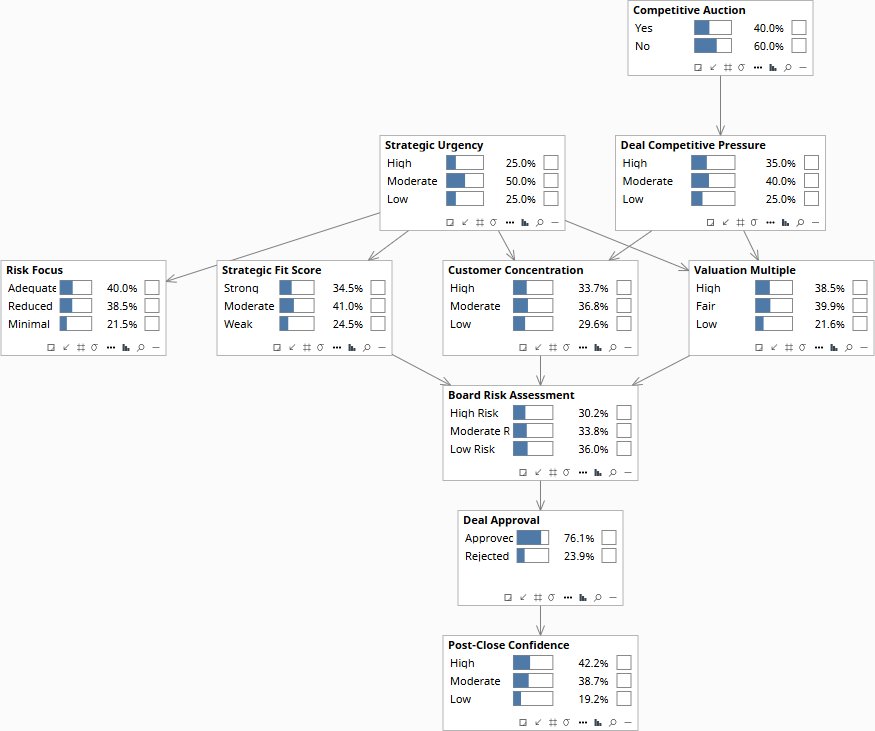
Before any evidence is entered, the three board concerns, valuation, strategic fit, and customer concentration, are independent and weighted roughly by their historical base rates.
Rung 2, Intervention: earnout structure
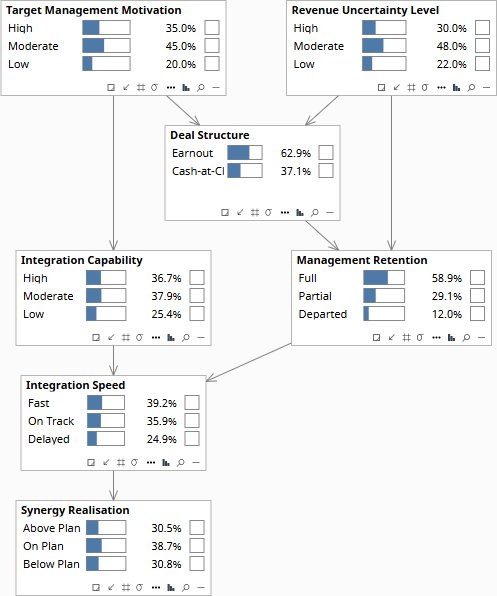
At the prior, the population-average 12-month management retention rate reflects the full mix of deal structures across the acquirer’s historical portfolio.
Rung 3, Counterfactual: the retention clause
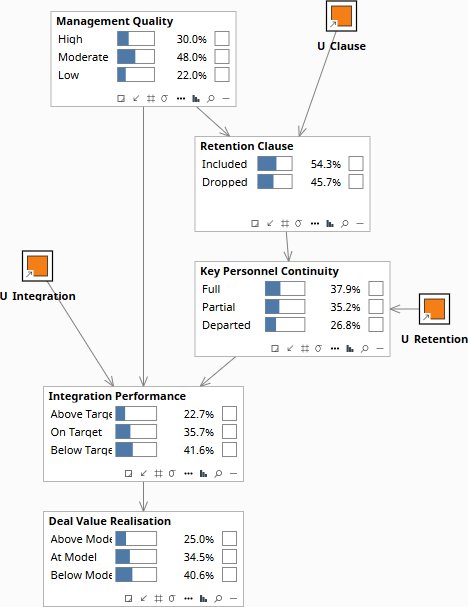
Before any evidence is entered, the model reflects the population prior for M&A integration outcomes across deals of this type and size.
05 Just Ask
The model is a file, not a locked tool. Any capable LLM can load the model’s XML and reason over it, so anyone on the deal team can interrogate retention, earnout structure, or board concern attribution in plain English and still get answers that keep seeing, doing and imagining apart.
Same model, same three rungs, just driven in conversation. The audit trail is the .bayes file, not a black box.
- Covenant design. Which covenant would most reduce downside risk on the next deal?
- Portfolio stress test. How would this risk factor propagate across other holdings?
- Renegotiation value. What is the expected value of reopening this specific term post-close?
- Early warning. Which leading indicator would have flagged this underperformance earliest?
- Comparable deals. Does this same risk factor explain underperformance in other portfolio companies?
06 The Engagement
If your deal committee is weighing three board concerns that all intensified during the competitive process, the diligence data cannot tell you whether those concerns are independent risks or the same upstream problem wearing three different faces. Elicit the structure from your deal team, parameterise it from your historical portfolio, and walk away with a model your board can interrogate on the next deal.
MADueDiligenceCausal.bayes: All Three Rungs
25-node causal model covering the full M&A due diligence lifecycle. Rung 1: enter obs(Deal Approval = Approved) then add obs(Competitive Auction = Yes) and obs(Strategic Urgency = High). Rung 2: compare do(Deal Structure = Earnout) vs obs(Earnout). Rung 3: abduct with obs(Retention Clause = Dropped) + obs(Integration Performance = Below Target), then do(Clause = Included).
This case study is a composite drawn from published M&A research, integration practice literature, and corporate finance case studies. Specific figures are representative. No individual organization or engagement is described. The Bayes Server models are working files: download, set evidence, and run inference.
The Deeper Trade
The model does not replace the expert who built it. It frees her from being the bottleneck for every routine version of this question, so she can spend her judgment on the cases that actually need it, and keep making the model better.