The Bet Beneath the Layoffs
ExecutiveThis year's tech layoffs are a bet that AI can replace domain experts. EARA is built on the opposite bet: don't replace the expert, formalize what they know into something explainable, durable, and cheap to run.
01 What the Layoffs Actually Show
Something strange is happening in tech right now. Companies are posting record profits and revenue while laying off tens of thousands of people, citing AI as the official reason. Roughly half of this year's tech layoff announcements name AI, automation, or machine learning as a driving factor. The same firms doing the cutting are committing hundreds of billions of dollars to AI infrastructure at the same time.
The market is not entirely buying it. Firms that cite AI as a reason for layoffs have gone on to underperform the broader market in the following weeks. Economists point out that tariffs, geopolitical uncertainty, and plain post-pandemic overhiring explain a good share of the cuts that get an AI label anyway. One outplacement firm's analysis expects a rehiring wave once companies discover how much human oversight the work actually needed.
Whatever the exact mix of causes, the pattern underneath is consistent. A bet gets made that AI can replace a category of human judgment. The staff go first. Whether the bet was right gets found out later, if at all.
02 A Bet on Rented Reasoning
Look closely at what the bet actually is. It is not "AI can do this work." It is "a vendor's model, at whatever price and quality that vendor sets going forward, can do this work, indefinitely."
That is a different bet, and a much shakier one. The capability being relied on is rented, not owned. Its quality, its price, and its availability are all decided somewhere else. When any of those three move, and all three have moved sharply in the last two years, the organization has already let go of the people who used to be the fallback.
A business function built this way has no floor under it. It has a subscription.
03 Where the Reasoning Actually Lives
EARA is built on a different composition, stated plainly on the Cognition page: cognition = language_interface ∘ causal_model.
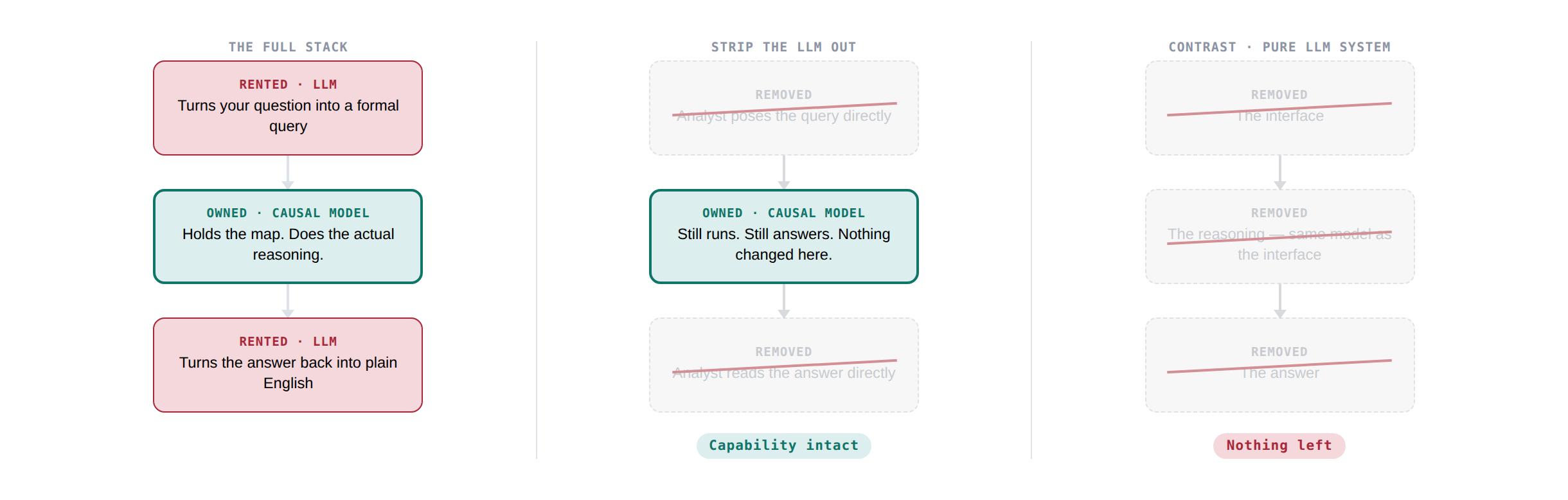
Read the composition literally. The causal model does the reasoning: the map of what drives what, fitted to your domain, capable of association, intervention, and counterfactual queries. The language interface sits at the two edges: it turns a plain-English question into a formal query, and it turns the formal answer back into plain English.
Neither edge is where the hard work happens. The hard work is the map. The map is not an LLM, and it does not need one to function.
04 What Happens When You Strip the LLM Out
Try the thought experiment. Remove the language interface from both ends of the composition. What is left?
A causal model that still runs. An analyst can pose a query directly against it and read the answer directly off it, no natural-language layer required. The organization's actual capability does not degrade if a vendor deprecates a model, changes its pricing, or has a bad quarter. Only the convenience layer needs replacing, and any capable language model can fill that role, because the hard reasoning was never asked of it.
click to enlarge →
Under EARA, the LLM is a nice-to-have: remove it from either side and the causal model keeps running. Under a pure-LLM system, the LLM is the whole system: remove it and nothing runs.
05 The Cost Argument
Running inference on a fitted Bayesian network is computationally cheap: junction tree propagation over a graph you already own, not a forward pass through a model with billions of parameters. Once the model exists, the marginal cost of asking it a question is close to zero.
The expensive part of the current wave is not reasoning about a well-scoped domain question. It is routing every one of those questions through a general-purpose language model, including the large share of them that are the same handful of structured queries a domain expert already knows how to ask. EARA pays the expensive part once, during elicitation and model-building, and the cost per query afterward barely moves with token pricing at all.
06 The Legibility Argument
A fitted causal model is auditable in a way a language model's internal reasoning is not. If a cost or resilience figure moves, you can ask the model which upstream factor moved it, and by how much, the same attribution query a supply chain model answers by tracing a rollup node back to its causes.
You cannot ask that of "the model recommended X." That auditability is what lets an organization keep asking whether a capability is still worth what it costs, on an ongoing basis, rather than finding out eighteen months later, after the layoffs, that the capability was never really there.
07 The Layoffs Are the Tell
The current wave is a bet that AI replaces the domain expert.
EARA is the opposite bet: don't replace the expert, formalize what they know into a durable, low-marginal-cost asset that outlives any particular LLM's pricing or availability, and keep the human in the loop exactly where their judgment is what's being asked for: building the model, validating it, and interpreting the query results that matter.
That's a structurally different relationship to the same underlying anxiety this year's layoffs are describing.
Two bets, both responding to the same set of facts: AI is expensive, and it takes a human being to develop it and use it well. Only one of the two bets treats those facts as a reason to keep the expert instead of cutting them.
cognition = language_interface ∘ causal_model, is stated in full on Cognition. What a domain expert's role looks like once the model exists is covered in Engagement.