Pearl’s Ladder
ExecutiveThree rungs. Each one answers a different class of question. Most enterprise AI operates only on the first.
01 The Hierarchy
Seeing, doing, imagining. Each level requires strictly more than the one below.
The ladder is a hierarchy of reasoning. Each rung requires strictly more than the one below it. You cannot answer a Rung 2 question with Rung 1 tools, and you cannot answer a Rung 3 question with Rung 2 tools. Most enterprise AI operates exclusively at Rung 1.
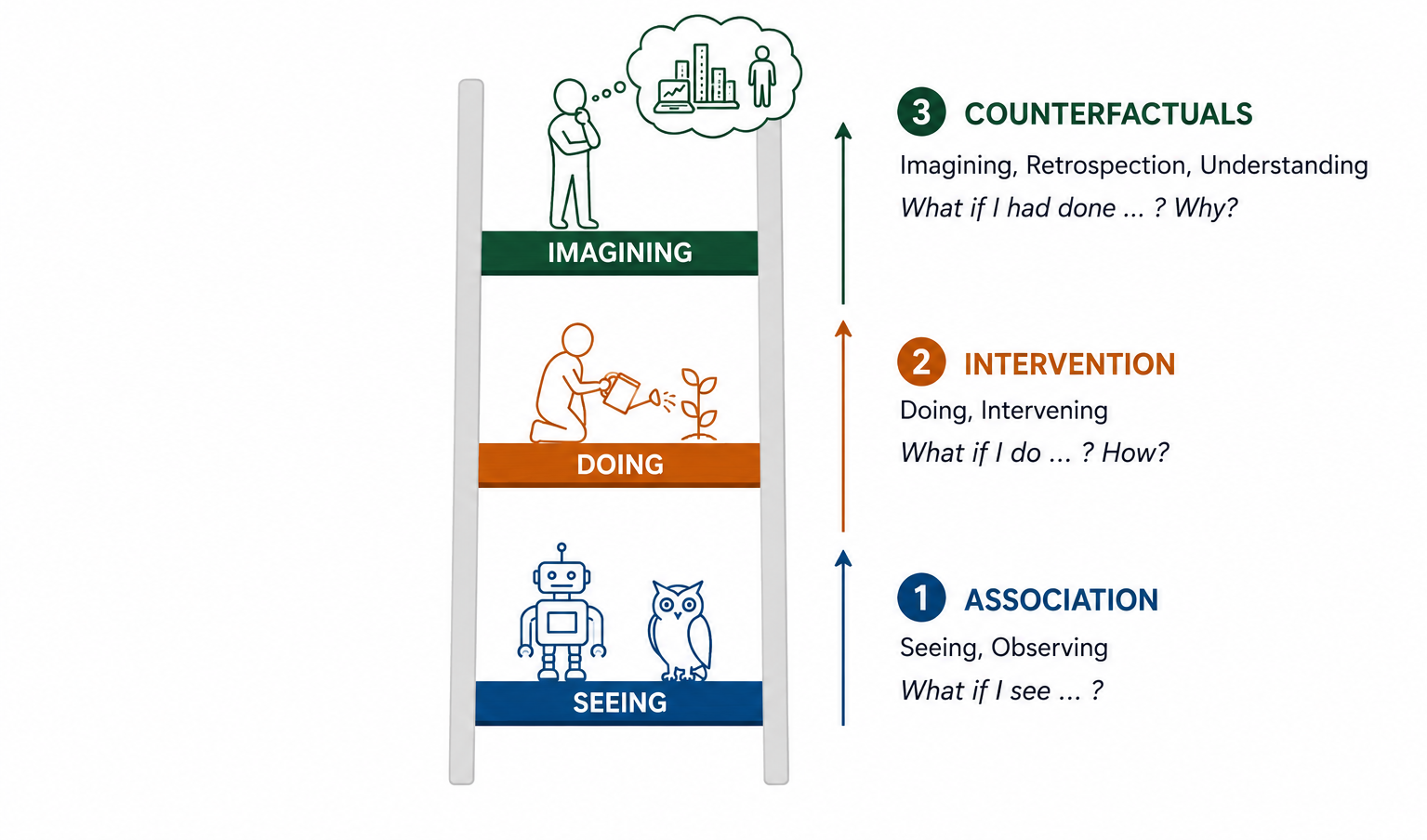
Judea Pearl & Dana Mackenzie, The Book of Why: The New Science of Cause and Effect, Basic Books, 2018.
02 Rung 1, Association
What goes with what? Every statistical model lives here.
The first rung answers the question: what goes with what? Given that I observe X, what should I expect about Y? This is a question about the joint distribution of observed variables, P(Y | X). It is answered by looking at data.
Rung 1 questions: What is the probability of default given that credit utilisation is above 80%? How does patient mortality correlate with length of stay? What is the seasonal pattern in demand? These are observational questions. Regression, machine learning, and forecasting all operate at this rung.
Rung 1 is not wrong. It is indispensable for prediction, screening, and description. The problem is that most enterprise decisions are not Rung 1 questions. They are questions about what to do, what caused an outcome, or what would have happened. Those are Rung 2 and Rung 3 questions, and they require more than data.
03 Rung 2, Intervention
What would happen if we acted? Correlation cannot answer this.
The second rung answers the question: what would happen if I did something? Not what goes with what in the data, but what would Y be if I set X to a particular value, regardless of what normally causes X to be that value. This is the do-operator: P(Y | do(X = x)).
Rung 2 questions: If we increase the marketing budget by $1M, what would revenue be? If we mandate structured interviews, how much would bias scores fall? If we de-energise this circuit during a Red Flag Warning, what is the ignition risk? These questions require knowledge of the causal mechanism, not just the correlation.
The difference between Rung 1 and Rung 2 is confounding. Observing that firms with high training spend perform well does not tell you whether training causes performance, better-managed firms may do both. The do-operator severs the incoming edges to X, removing confounding and isolating the causal effect.
Rung 2: P(Y | do(X=x)), what Y would be if we set X=x
These are equal only under randomisation.
In observational data they diverge whenever X has confounding causes.
04 Rung 3, Counterfactual
What would have happened for this specific case? The hardest question, and the one courts actually ask.
The third rung answers the question: what would have happened in this specific case if something had been different? Not on average across the population, but for this patient, this decision, this incident, given everything that actually occurred.
Rung 3 questions: Would this patient have survived if treatment had started four hours earlier? Would this candidate have been promoted if she had been male? Would this fire have started if the fitting had been replaced? These are but-for questions. They underpin legal liability, root-cause analysis, and post-mortem accountability.
Rung 3 requires three steps: abduction (anchor the model’s background conditions to what was actually observed), action (intervene on the counterfactual variable), and prediction (read the outcome). The background conditions, the U-nodes in a structural causal model, represent everything idiosyncratic about this case that the structural parents do not explain. Locking them in is what makes the counterfactual specific to this case rather than a population average.
When you abduct, you extract a particular case from the averages, locking in its idiosyncratic circumstances before asking what would have happened if one or more things had been different.
In EARA terms: cognition = language understanding × causal reasoning. Either factor zeroed out collapses the product, though “×” is a simplification; see why “×” is the wrong operator. An LLM approximates Rung 1 at scale. Rungs 2 and 3 require a structural causal model that can execute do-calculus and abduction. Cognitive Primitives →
Rung 3 produces individualized answers, but not through personalization. The individuation is a property of causal inference, not of user data. The structural equations and U-nodes lock in the idiosyncratic circumstances of this case. The system doesn’t know you; it knows the mechanism. That is a more defensible kind of individual answer than anything a recommendation engine can produce.
Consumer AI personalizes. Causal AI individualizes. EARA goes further: it reasons about what would have happened to this specific case under conditions that never occurred. Personalized medicine, or any domain where the individual case matters, isn't a marketing term. It's a Rung 3 capability, and it's what the architecture is built for.
05 Where most enterprise AI stops
Prediction is not decision support. Scoring is not causation.
Most enterprise AI systems operate at Rung 1. They predict. They score. They flag anomalies. These are all Rung 1 operations, they describe the distribution of observed data.
Prediction is not decision support. Knowing that P(default | features) = 0.73 does not tell you whether approving this application would cause a default. It tells you that among applications with similar features, 73% defaulted. What would happen if you changed the credit limit is a Rung 2 question. Whether this specific applicant would have defaulted under a different lending policy is a Rung 3 question.
The gap matters most in regulated contexts. A regulator does not ask what the model predicts. It asks why the decision was made, what the causal basis for it was, and what would have been different under an alternative policy. These are Rung 2 and Rung 3 questions. A Rung 1 system cannot answer them, not because it lacks data, but because it lacks the causal structure needed to separate observation from intervention.
06 Climbing the ladder
Each rung requires more structure. The structure is what makes the answer trustworthy.
Moving from Rung 1 to Rung 2 requires encoding the causal structure, which variables cause which, as explicit directed edges. That structure cannot be read off the data alone; it must be elicited from domain experts, the people who know how the system works.
Rung 1 to Rung 2: encode the DAG. Once the causal graph is explicit, the do-operator is mechanical: sever the incoming edges to the intervention variable and run inference. The back-door criterion, the front-door criterion, and do-calculus are the identification tools that tell you whether a Rung 2 quantity is estimable from available data given the graph.
Rung 2 to Rung 3: add U-nodes. Structural causal models encode background heterogeneity as exogenous noise terms, one per endogenous variable. These U-nodes are the mechanism that makes counterfactuals specific to a case rather than population-level. The Balke–Pearl response-function encoding handles discrete variables; CLG models handle continuous ones.
Each rung is strictly more powerful than the one below it, and each requires more structure: Rung 1 needs data, Rung 2 needs a causal graph, Rung 3 needs a structural causal model with explicit noise terms. The additional structure is not a burden, it is what makes the answers trustworthy enough to act on and audit.
07 In practice
Every deliverable on this site can be located on the ladder.
Pearl’s Ladder is the intellectual spine of this practice. Every deliverable can be located on it. The Rung 1 question (what is the current probability?) is answered by the model’s prior or by entering observed evidence. The Rung 2 question (what would happen if we acted?) is answered by the do-operator. The Rung 3 question (what would have happened?) is answered by abduction followed by intervention.
Risk Domains. Every CASE2 page on this site is organised around the three rungs: diagnostic inference (Rung 1), intervention analysis (Rung 2), and counterfactual (Rung 3). The model does not change between rungs. The question does.
The Architecture. The Pipeline routes each incoming query to the correct rung before running inference. Parse identifies the rung from linguistic markers; Formalize makes it a typed estimand; Execute runs the appropriate computation. The rung is a first-class dimension of every query, not an afterthought.
Legal and regulatory contexts. Courts ask but-for questions (Rung 3). Regulators ask intervention questions (Rung 2). Audit functions ask diagnostic questions (Rung 1). A system that operates only at Rung 1 cannot serve the other two, regardless of how accurate its predictions are.