Without a Causal Model, Your AI Can’t Reason.
ExecutiveHere’s the architecture that gives your AI the causal model it needs to reason. It can be built by your own people.
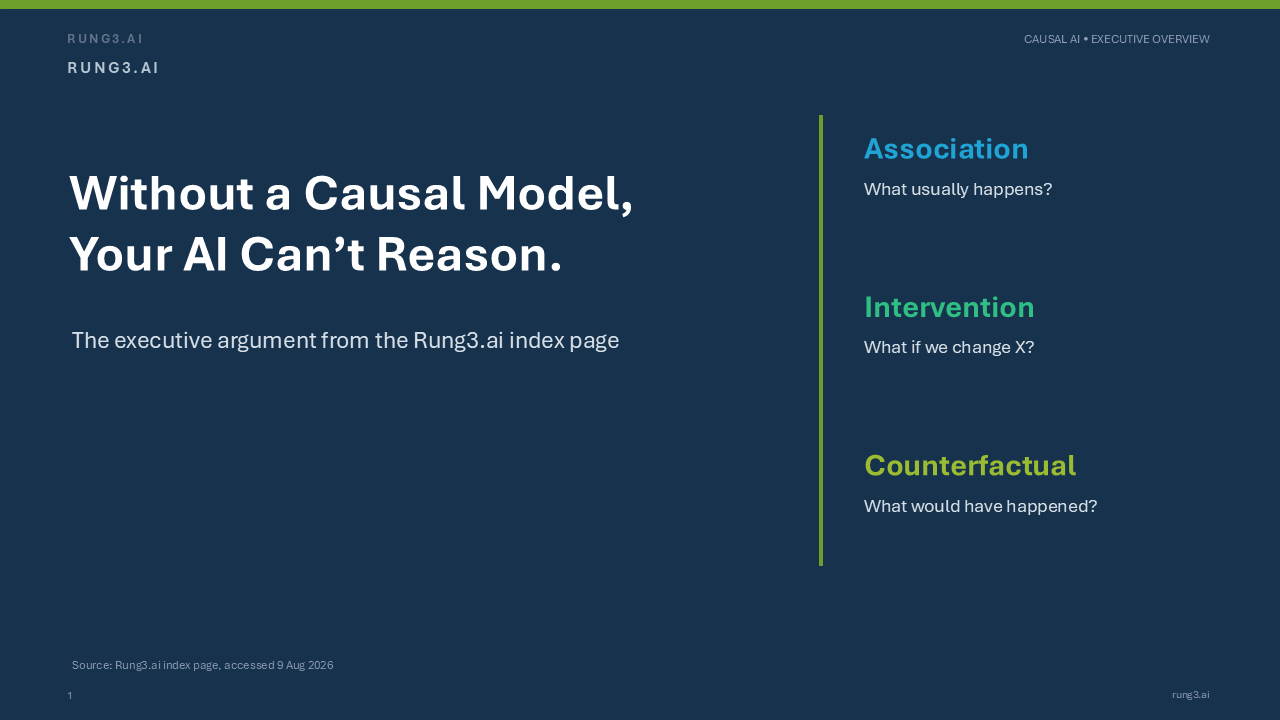
Causal AI · Executive Overview
The full argument as an 11-slide deck — the same case made on this page, in slide form.
It Can Answer These Questions
What’s happening right now? Description, summary, classification.
What usually happens when X occurs? Pattern, correlation, spotted in the data.
Why do these seem to go together? An association, explained, still just an association.
But It Can’t Answer These
What will happen if we change X? Requires knowing what to hold fixed and what breaks. An LLM alone is guessing.
What would have happened if X had been different? Requires reasoning about a world that never occurred. No amount of fluency answers this.
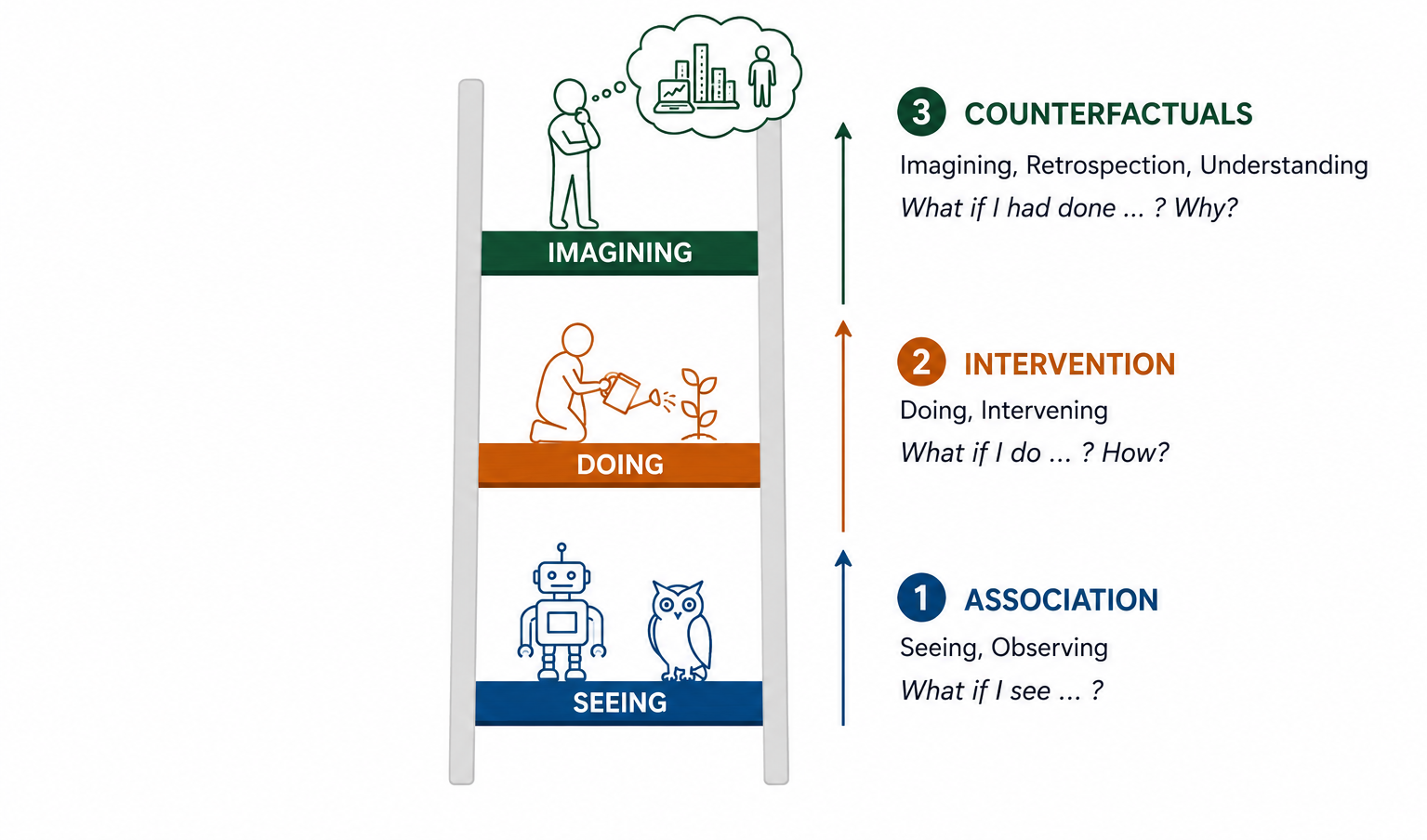
Causality is the difference. The first three questions are association, Rung 1. The two questions it can’t answer are intervention and counterfactual, Rungs 2 and 3, and they are exactly the capability a domain plug-in adds.
It Frees Your Expert, Not Just Your AI
An expert’s reasoning is what the model captures. Once captured, it answers every routine version of a question she’s already answered a hundred times, the same way, at any hour. She’s freed for what it cannot touch yet: the cases that need her judgment, the craft that made her worth eliciting, and the next model.
It’s Easier Than It Sounds
The hardest part isn’t technical. It’s getting the right people in a room for a few hours to say what they already know. If your experts will talk, we can build the model.
This Is What Makes It “AI”
A chatbot that talks fluently but doesn’t understand your business isn’t intelligent. It’s autocomplete. Connecting it to a model of your own cause-and-effect is what puts the reasoning in artificial intelligence.
It Doesn’t Need Us Forever
Your people learn to read, question, and extend the model as it’s built. When the engagement ends, the skill stays on your team, and the next model costs less than the first.
What You’ll Learn
- Whether your business has a problem this solves
- Whether this is a practice worth trusting with it
- Exactly what you’d own at the end, and what it costs to get there
- How to make your LLM smarter, not by making it bigger, but by giving it something real to reason with
01 Three Pages, Three Questions
The first answers “is there a problem here worth solving?” The second answers “is this person worth hiring?” The third answers “what exactly would I be buying?”
Mixing them into one page serves none of them. Read whichever one matches where you are.
02 The Value Proposition
The Value Proposition is the argument in its shortest form.
The core claim: the knowledge your AI is missing is not sitting in your data. It is in your experts’ heads, the operators, underwriters, and engineers who know how the system behaves. No amount of additional data extracts it, because it was never written down.
The page makes the case for why that gap matters and what closing it is worth. Fifteen minutes.
03 Due Diligence
Due Diligence is the page you read before signing anything.
The practice, the deliverables, and the person behind it. What you receive at the end of an engagement, how the work is done, and the background that supports the claims made elsewhere on this site.
It is deliberately not a sales page. If the first page did its job, this one only has to be accurate.
04 The Engagement
The Engagement is the page for the moment you are deciding whether to fund something.
Three phases, what your people have to give up in time, the eight named artifacts you own at the end, and the smallest version worth starting with. It puts a figure on the floor rather than making you ask.
Read it before the first conversation, not after. The most common reason this work stalls is expert availability, and that is something worth checking inside your own organisation before you talk to anyone.
05 Where to Go Next
The rest of the site is four columns, each with its own overview.
Domain Plug-Ins: what this looks like in your industry. Start here if you want to know whether the shape of your problem matches.
Design Rationale: why the practice is built this way, and what it rejects. Start here if you are skeptical, which is a reasonable thing to be.
Operations: what happens between your question and the answer. Start here if you want to know how the work gets done.
Going Deeper: longer essays on how models get built and where this fits in the wider AI landscape, including why this year's AI layoffs are the argument for owning your own causal model, not renting someone else's.
06 If You Have Ten Minutes
Read The Value Proposition, then Pearl’s Ladder.
The first tells you what problem this solves. The second gives you the framework that every other page on the site assumes. Together they are enough to decide whether the rest is worth your time, which is the only decision this column is trying to help you make.
Is the problem real, is the person credible, and what exactly would I be buying? Three questions, asked separately, answered separately.