Due Diligence
ExecutiveThe person behind the practice, the intellectual foundation it is built on, and what you own when the engagement ends.
Executive Summary
Marc Vandenplas built this practice on one recurring gap seen across twenty-five years of C-suite consulting: tools that describe what happened, with no reasoning connecting that to what to do next. The fix is Pearl’s causal inference framework, applied as Bayesian causal models built from your own experts’ knowledge. Every engagement produces a working model your team owns outright, plus the governance record behind every answer it gives. Engagements begin with a single decision domain and scale from there, built for organizations making consequential decisions under uncertainty, not for routine reporting.
01 The Person

Prediction is not decision support. That is the throughline across twenty-five years consulting to C-suite and executive teams across insurance, banking, energy, cybersecurity, supply chain, healthcare, and public sector. The same structural gap in every engagement: tools that describe what happened, leaders who need to know what to do, no clear line of reasoning connecting the two.
Causal AI is the answer. I came to it through Pearl’s work and through repeated encounters with decisions that looked analytical but were actually logical, questions that no amount of better data or fancier models would answer, because the answer required reasoning about interventions and counterfactuals, not correlations. That is what this practice does.
AI · Data Science · Business, Stanford, Johns Hopkins, Golden Gate University (MBA), San Francisco. NASD Series 7.
02 The Foundation
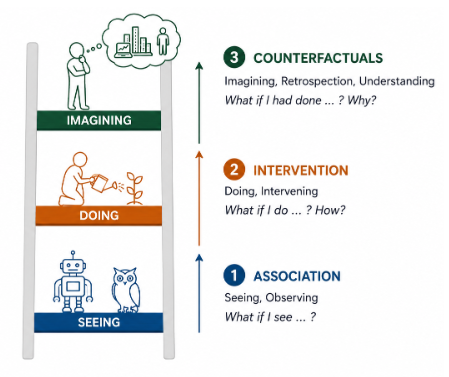
The intellectual foundation is Judea Pearl’s causal hierarchy, the Ladder of Causation. Most enterprise AI operates only at Rung 1: association. This practice operates at all three rungs.
Rung 1: Association. What is the situation given what we observe? P(Y|X). The LLM approximates this at scale, but confounds cause and correlation.
Rung 2: Intervention. What would happen if we acted? P(Y|do(X)). Cannot be computed without a model of mechanism.
Rung 3: Counterfactual. What would have been different? Requires structural equations and the twin-network method. This is the question regulators, courts, and post-mortems ask.
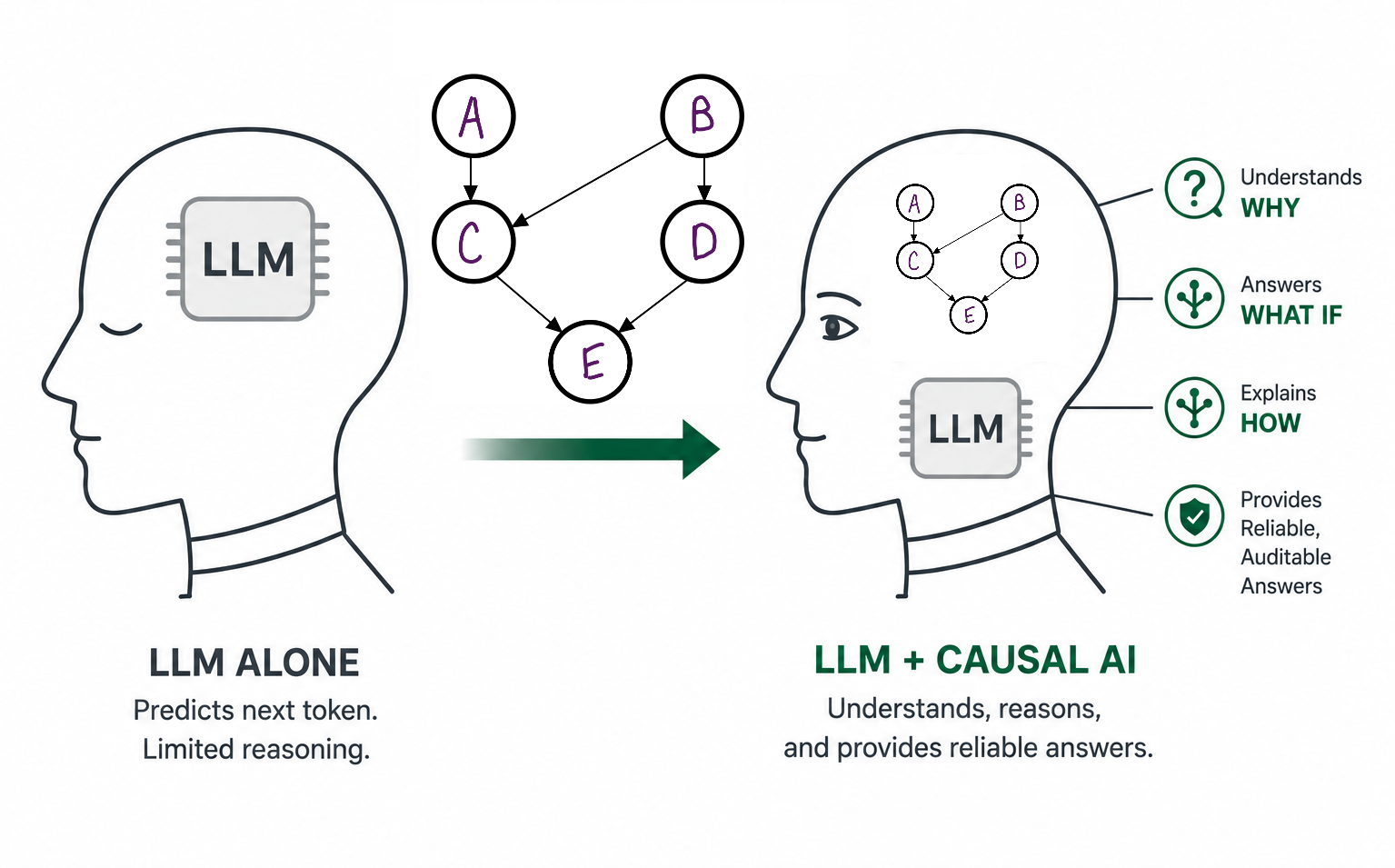
My choice of modeling engine is Bayes Server, named in Gartner’s Hype Cycle for AI, the industry’s leading platform for Bayesian networks and structural causal models. That said, the architecture is engine-agnostic: any platform that supports structural causal models and exposes a query API can serve the same role. Every .bayes file produced in an engagement is a valid, inspectable model built to documented standards. The library of pre-built domain models is the accumulated result of applying this method across industries. Full methodology →
03 The Deliverables
A working model your team owns outright: the causal model, the language interface to your existing LLM, and the governance record behind every answer it gives.
Transferred skills. The engagement is also a working session. Your domain experts learn to read, challenge, and extend the model. When the engagement ends, the capability stays, and it doesn’t need us forever. The next model costs less than the first.
See the full list of what you receive, with a worked example of each, on the Deliverables page.
04 The Engagement
We begin with the domain plug-in for your industry, the vocabulary and structure already mapped, so the engagement doesn't start from a blank page. We team with your experts to calibrate it to your specifics. The entry point is a single decision domain, the one your team is arguing about, the one your board keeps asking for, the one that comes back every quarter without a clean answer.
Typical scope. Four to eight weeks. One decision domain. One .bayes file with a documented assumption set and a language interface your team can query from day one. Skills transfer included.
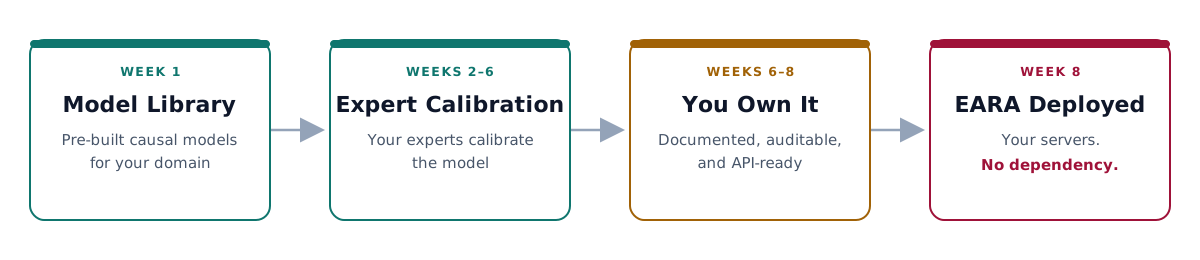
Subsequent engagements extend the library: a second domain, a second model that composes with the first, or a deeper treatment of the same domain at the counterfactual level, answering not just what will happen, but what would have happened.
The smallest commitment. A half-day working session on one decision domain. No further obligation. We map the decision, identify where your current tools fall short, and scope what a model would need to cover. You decide whether to proceed.
To start a conversation, email info@rung3.ai or connect on LinkedIn. The conversation is easier when the specific decision is on the table.
05 Who It's For
Organisations where consequential decisions need to be justified, not just made, and where the standard analytical tools answer the wrong question.
Risk and underwriting. Which factors caused this loss, separated from the factors that merely accompanied it. Rate interventions modelled to loss probability. Attribution that is defensible in review.
Cybersecurity and compliance. What a control change would do to expected loss. Which combination of investments is worth buying. What the SEC, SOX, or NIST audit trail requires.
Strategy and capital allocation. Which option maximises expected value, with the assumptions named. What would have been different if the decision had gone the other way.
Operations and reliability. Which interventions most reduce failure probability. Whether replacing that specific component would have prevented that specific incident.
Healthcare. Which exposure drove this outcome, and for which patient. Which treatment path produces the best expected result. What the counterfactual rate would have been.
If your decision requires knowing what would happen if you acted, what caused a specific outcome, or what would have been different, that is a causal question, and this is the practice that answers it.
- Judea Pearl & Dana Mackenzie, The Book of Why: The New Science of Cause and Effect, Basic Books, 2018. Pearl’s causal hierarchy organises reasoning into three rungs: association (seeing), intervention (doing), and counterfactual (imagining).