What It Takes
| What is required | Why |
|---|---|
| Domain expert time | The causal claims must come from people who understand the domain. Typically 2–4 experts per model, for structured sessions of a few hours each. |
| Executive sponsorship | Prioritisation decisions require someone with authority to say which decisions matter most and which experts should be involved. |
| Willingness to commit to causal claims | A causal model is a set of explicit claims about what drives what. That is harder than a heatmap and more useful than one. Experts must be willing to put their name on the structure. |
| Iteration tolerance | The first version of a model is a starting point. It improves as it is tested against real decisions. Organizations that treat the first version as final get less value than those that treat it as a living document. |
How the engagement works
Phase 1 — Make It Explicit
LLMs cannot replicate this — their outputs have no connection to your organization’s specific causal structure. The first working model typically takes a day. Subsequent models take hours.
Phase 2 — Find the Bottlenecks
| Prioritize domains where… | Because… |
|---|---|
| Decisions are high-stakes and recurring | Every wrong call costs money. Systematic errors compound. The person whose judgment prevents them shouldn’t be the only safeguard. |
| Counterfactual questions land on the same desk | “Would this have happened if we’d acted differently?” is a question your senior people answer by instinct. A model answers it by computation — and they stop being the bottleneck. |
| Key experts are approaching retirement | The underwriter who knows why mountain routes perform differently. The actuary who understands the cascade. When they leave, so does the reasoning — unless it’s been encoded. |
| Regulatory defensibility is required | “The model said so” is not a defense. The reasoning behind a decision needs to survive the person who made it. |
Phase 3 — The First Transfer
Each model is yours outright — not licensed from a vendor, not hosted in someone else’s system. The first version is a starting point; it sharpens as it is tested against real decisions. The engagement ends when your team can extend the library without me.
Phase 4 — From Holders to Architects
As the library grows, models begin to interlock. A credit risk model and a customer behavior model, connected through a shared variable, can answer questions that neither could answer alone. The senior analyst who previously sat at the center of every cross-domain query is no longer the bottleneck — they’re the architect of a system that routes those queries automatically.
This phase has no end date — and that is the point. Each review cycle produces new observations that update the model’s parameters. The library that informed last quarter’s decisions is more accurate this quarter than it was last quarter. No black-box system compounds this way.
Your IP. Your library. LLMs can be an interface.
A large language model can query the library, translate questions into causal queries, and translate answers back into plain English. It is a capable interface — but it is infrastructure. It contributes nothing to the reasoning itself and nothing to the IP. The reasoning lives in the graph: explicit, inspectable, owned by your organization.
Any LLM can be swapped in or out. The library cannot be — because it encodes your experts' understanding of cause and effect, and no competitor can replicate that from the outside.
The Strategic Payoff
The library provides the causal engine. The engagement calibrates how your organization values different outcomes — every discussion of which results matter and how much is a utility calibration exercise. And Bayesian networks update automatically as new evidence arrives: the model that informed last quarter's decisions is more accurate this quarter. No black-box system compounds this way.
What Regulators Will Ask
The EU AI Act, FDA guidance on clinical decision support, and financial services supervisory frameworks all converge on the same requirement: not just that a rule was followed, but that the decision was defensible given what was knowable at the time. That is a counterfactual question. It requires a causal model to answer.
| Requirement | How the architecture delivers |
|---|---|
| Explain decisions to regulators | Every inference traces a path through the causal graph. The reasoning is the structure — which variables cause which, with quantified effect sizes. |
| Provide audit trail | Every answer records which model was used, which data was queried, which individual factors were inferred, and how the counterfactual was computed. Fully reproducible. |
| Quantify confidence | Bayesian posteriors propagate uncertainty through every causal link. The system knows — and reports — when it is uncertain. |
| Withstand adversarial scrutiny | A plaintiff's attorney, a regulator, or an insurance adjuster can inspect every arrow, every equation, every assumption. The model defends itself by being transparent. |
What It Can't Do
So what does this mean for you?
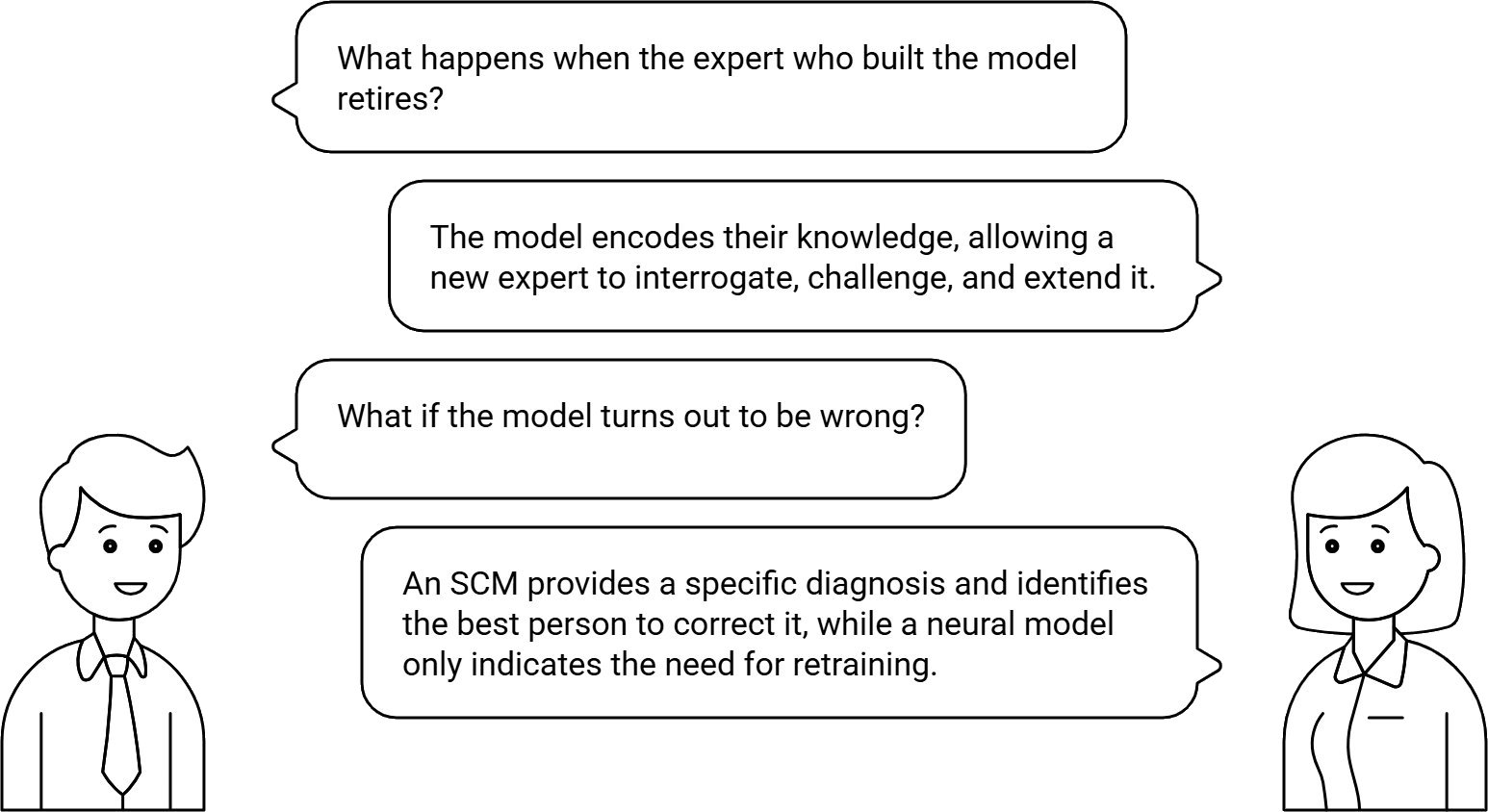
Explicit assumptions are assumptions your people can read, challenge, and improve over time. When a model is wrong, you can find and fix the assumption that failed. When a black-box model is wrong, you start over. The library compounds. The black box doesn't.
Honest AI that your organization can actually own is harder to build than a black box. It is also the only kind worth building.
The critical assumptions are structural: which variables belong in the model, which arrows are drawn, and which causal claims your experts are willing to commit to. Get those right and the probability tables follow. Get them wrong, and the model will be confidently wrong — but you can find and fix the error. With a black box, you start over.
The engagement starts with a conversation.
Bring two or three of your domain experts and one executive sponsor. In a half-day session, we will identify your highest-priority domains, walk through what a causal model looks like in your context, and scope Phase 1. If your models can’t answer what would have happened if you’d acted differently — that is the gap this addresses.
info@rung3.ai