The Three-Step Procedure
in practice
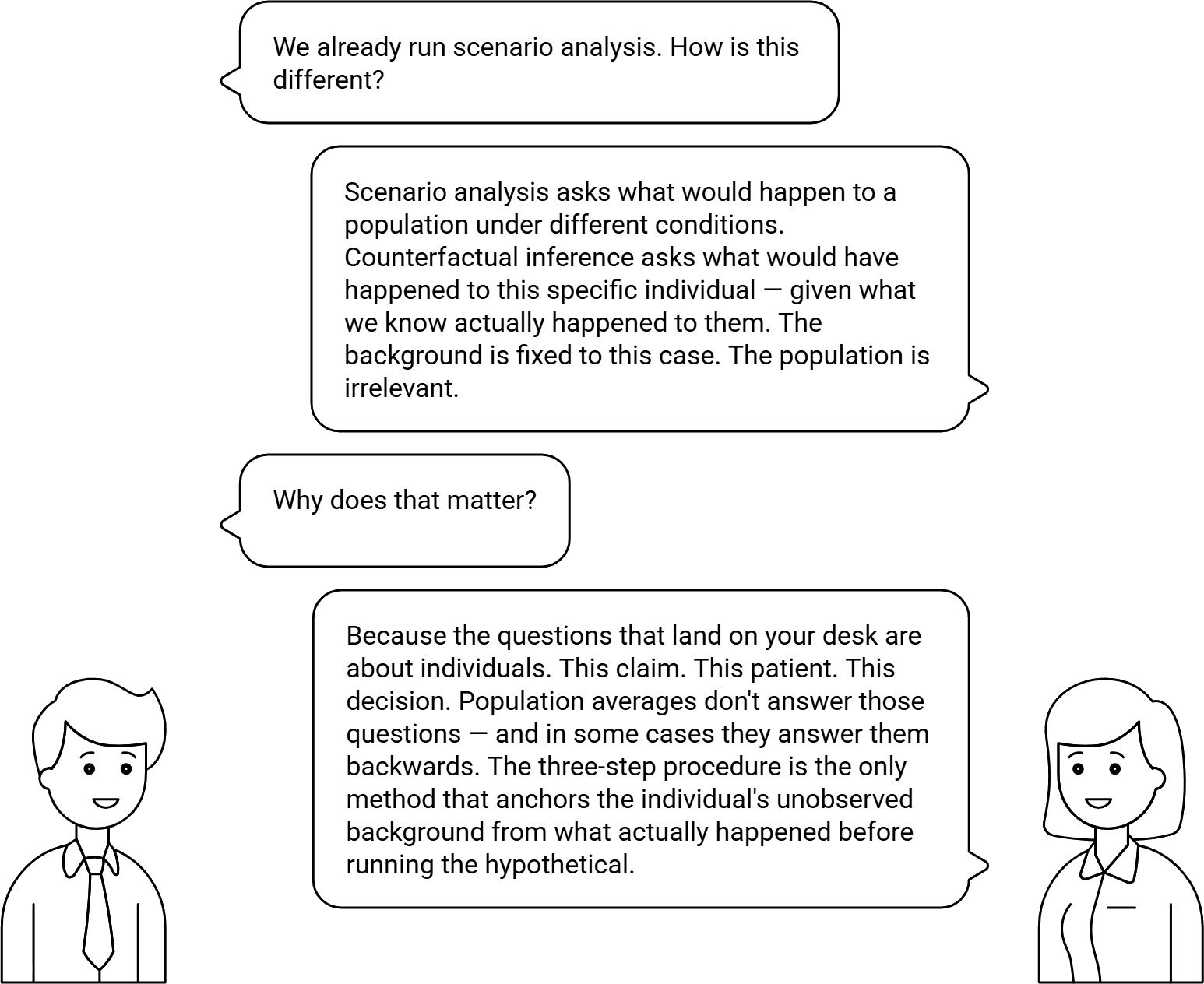
Every population model can tell you what tends to happen. Only a counterfactual model can tell you what would have happened to this specific case under different conditions — because it anchors the individual's unobserved background from what actually happened before running the hypothetical. Select a domain below and run all three steps on a real causal model.
Pick one of the two domains below to drive the procedure. Each card runs on a real Bayesian network — not a simplified illustration — so the same three steps execute against the live model, with your factual evidence in Step 1 propagating through to the individual-level counterfactual outcome in Step 3. Switch between cases at any time to see how the procedure generalizes across very different problem shapes.
Iatrogenic Medications
Given this patient's age, comorbidities, and actual outcomes — what would their hospitalisation risk have been on a different medication regime? The answer is for this patient, not the average patient.
Liability Attribution
Given the road conditions, all parties' conduct, and the actual collision outcome — what would Party B's fault share have been if they had driven at the lawful speed? The model encodes the causal chain the adjuster reasons through.