A Bayesian network is built for a specific class of problems. Four conditions identify them.
The strongest argument for using a BN is also the one most easily missed: it is the only structure that supports the questions decision-makers actually ask — what works, why, and what would have happened under a different choice. Where those questions live, the BN is the natural object.
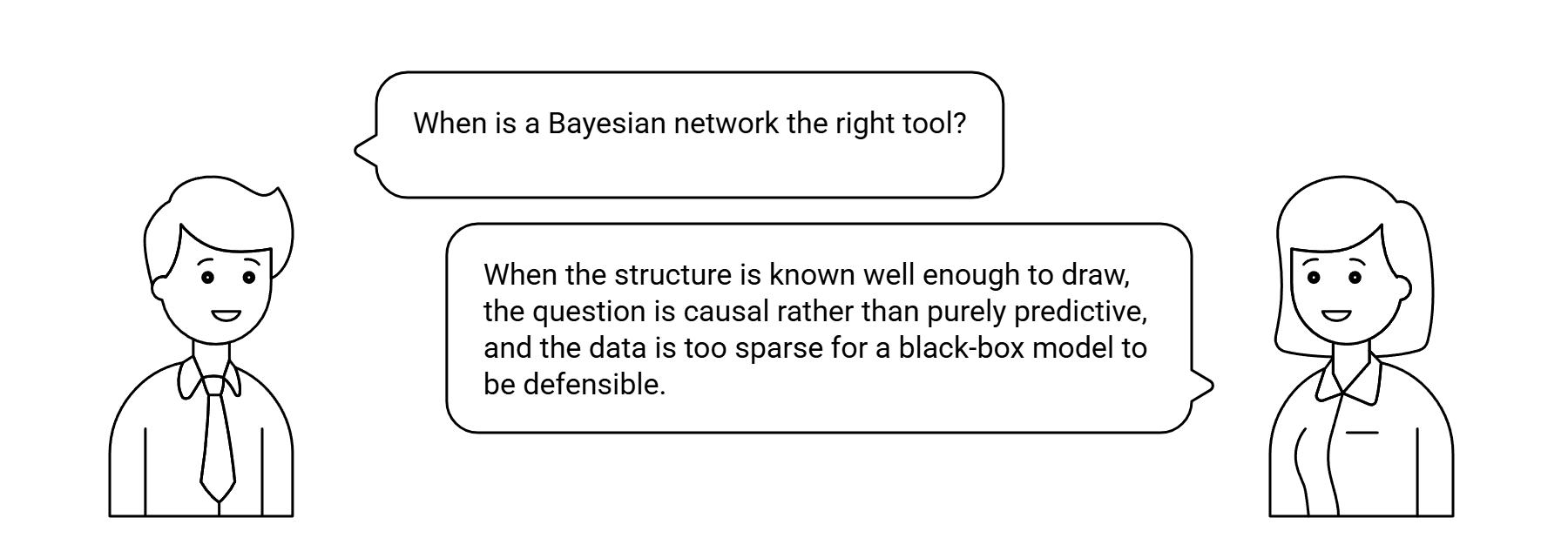
When the question is causal, not predictive
The question "what will happen?" can be answered by any tool that fits the historical distribution. The question "what would happen if we changed X?" cannot — it requires a structural model of the mechanism connecting X to its effects. Pearl's do-operator is the formal apparatus; a Bayesian network with explicit causal arrows is the artifact on which it runs.
This distinction is not technical. A predictive model is a description: under current conditions, this is what tends to happen. A causal model is a lever: if you change the world this way, this is what will happen. You cannot pull a description — and you cannot reason about an intervention without something that represents the mechanism the intervention disturbs.
Counterfactual questions go one step further. "Would the harm have occurred without the act?" — "Would the borrower have repaid under different terms?" — these demand a model that can be replayed under altered conditions while holding the unobserved background of the specific case fixed. That is the Rung 3 operation, and only a structural model supports it.
If your question's answer changes when you replace conditioning (filtering on what is observed) with intervention (forcing a value and severing it from its causes), you need a causal model. If the answer is identical either way, you don't. The test is structural, not statistical — and a BN is the simplest artifact on which it runs.
When knowledge is rich and data is thin
Modern predictive tools assume the dataset is large enough to recover structure from co-occurrence. In many high-stakes domains that assumption fails. New drugs are evaluated on hundreds of patients, not millions. Operational failures are rare by design. Regulatory standards encode what the law requires, not what the historical record happens to show. Insurance reserves the tail event that data alone cannot characterize.
In these domains, expert knowledge often exceeds what the data records. Engineers know the failure mechanisms; clinicians know the contraindications; lawyers know which omissions matter. A Bayesian network encodes that knowledge as a graph and a set of conditional probabilities that can be challenged, audited, and updated. Where data is scarce, the BN is the structure that lets the available knowledge do the heavy lifting the data cannot.
The complementary case — abundant data, weak expertise — is where a black-box predictor wins. The honest read of the data/knowledge axis: a BN earns its place when there is enough domain wisdom to draw a defensible graph, and the data alone would not get you to the same place.
When audit, transparency, and defensibility matter
A neural network's reasoning is opaque — even to the team that trained it. A Bayesian network's reasoning is laid out on the same artifact that runs the inference: the causal graph. A reviewer can ask "why is there an arrow from X to Y?" and the modeler must answer. Any disagreement becomes a disagreement about structure, named explicitly, not a complaint about a model's hidden internals.
This is not a stylistic preference. In regulated domains — drug approval, credit scoring, environmental compliance, insurance reserving, criminal proceedings — opaque models are increasingly unacceptable to regulators and to courts. A BN's transparency is the property that lets it be defended under adversarial review. The graph is the audit artifact. The CPT is the parameter committee. Both are inspectable; both are challengeable; both are updatable through the same review process that produced them.
The corollary: in domains where no one will ever ask "why did the model say that?", the audit advantage is wasted overhead. Where someone will — and "the model said so" is not an acceptable answer — it is decisive.
When the same structure must answer many questions
A predictive model trained for one task does not transfer to a different task without retraining. Build it to score default probability and it cannot tell you what an intervention program would have done. Add the intervention question and you have built a second model from scratch — with all the data preparation, validation, and governance overhead that implies.
A Bayesian network with a complete structural specification answers all three rungs of Pearl's hierarchy from the same graph: associational queries (Rung 1: P(Y | X)), interventional queries (Rung 2: P(Y | do(X))), and counterfactual queries (Rung 3: P(Yx | X′, Y′)). The marginal cost of asking the next question is small once the structure is in place. The fixed cost of construction is amortised over many uses.
For problems where the question itself keeps evolving — which is most problems worth modeling — this versatility is the deeper value. The BN is not built for a single question. It is built for the structure that underlies a family of questions.
The honest summary
Use a BN when: the goal involves intervention or counterfactual reasoning; expert causal knowledge is available and stronger than the data record; transparency and audit are required by regulators, boards, or adversarial review; or the same structure must serve multiple types of questions over its lifetime.
Use something else when: the goal is purely predictive and the distribution is stable; the causal structure is genuinely unknown and unknowable; the system is changing faster than the model can be updated; or real-time inference at scale is required.
The deeper point is that these are not competing ideologies. A BN is the right structure for a specific class of problems. The conditions are well-defined. Knowing when to use a tool is the other half of knowing when not to — and together they make a recommendation credible.
If your problem fits the four conditions — or you are not sure — the fastest way to know is to draft the question and see whether it survives the substitution test. We can do that in a half-day.
info@rung3.ai
| Condition | Use a BN | Use instead |
|---|---|---|
| Goal is intervention or counterfactual reasoning | ✓ | — |
| Expert causal knowledge richer than the data record | ✓ | — |
| Audit, transparency, or adversarial defensibility required | ✓ | — |
| Same structure must answer multiple types of questions | ✓ | — |
| Goal purely predictive, distribution stable, abundant data | — | Gradient boosting, neural nets, logistic regression |
| Real-time inference at scale required (<10ms latency) | — | Approximate inference (loopy BP, variational); compiled decision trees |
The deeper point is that these are not competing ideologies. A BN is the right structure for a specific class of problems. These conditions are not features of the approach to celebrate — they are the boundary conditions that define where the approach belongs. The companion page covers the mirror conditions.